
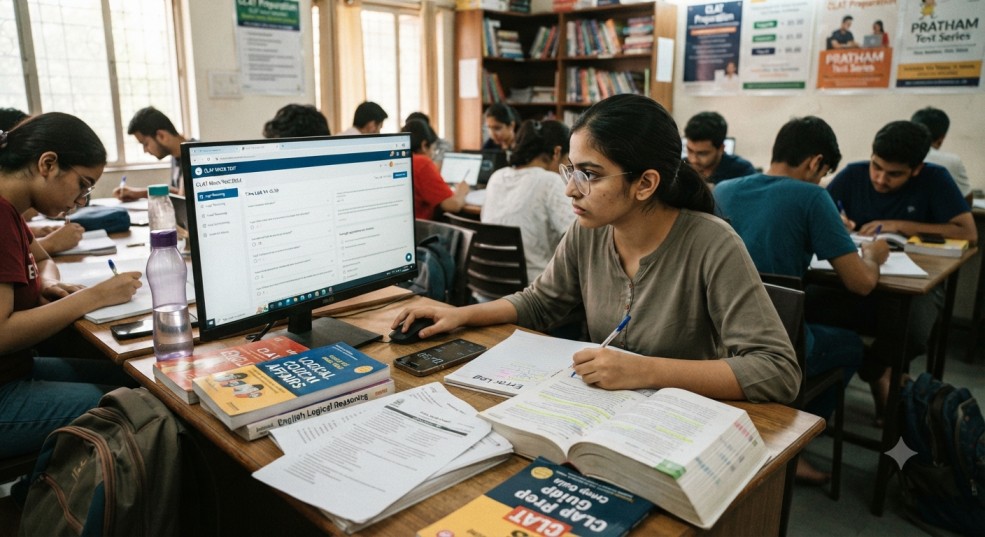
CLAT Error Analysis Guide: How to Turn Mock Test Mistakes into Improvement
Mock tests are an important part of CLAT preparation, but simply attempting mock tests is not enough. The real improvement begins when students carefully analyse their mistakes and understand why they lost marks.
A well-planned CLAT error analysis strategy can help students identify weak areas, reduce repeated mistakes, improve accuracy, and develop better time-management skills.
Instead of looking at a mock test only as a scorecard, treat every test as a learning opportunity.
Why CLAT Mock Test Analysis Matters
A mock test shows more than your total score. It can reveal your preparation patterns, including:
-
Which topics need more attention
-
Which questions consume too much time
-
Where careless mistakes happen
-
Which sections are relatively comfortable
-
Which question types create confusion
-
Whether your accuracy is improving
The purpose of mock analysis is not to feel disappointed about mistakes. It is to understand them and create a plan to avoid repeating them.
Step 1: Record Your Mock Test Performance
After every mock test, record your basic performance.
You can maintain a simple tracker:
| Mock Test | Attempted | Correct | Incorrect | Unattempted | Main Issue |
|---|---|---|---|---|---|
| Mock 1 | 85 | 65 | 20 | 35 | Time Management |
| Mock 2 | 90 | 72 | 18 | 30 | Accuracy |
| Mock 3 | 94 | 80 | 14 | 26 | Logical Reasoning |
This makes your progress easier to understand over time.
Do not focus only on the score. Look for patterns.
Step 2: Categorise Every Mistake
Not every wrong answer happens for the same reason.
Divide your mistakes into different categories.
1. Conceptual Mistake
You selected the wrong answer because you did not understand the underlying concept.
Solution:
Go back to the relevant topic, revise the concept, and solve additional questions.
2. Reading Mistake
You misunderstood the passage, question, or an important detail.
Solution:
Practise active reading and pay attention to keywords, arguments, conditions, and conclusions.
3. Careless Mistake
You knew the answer but marked the wrong option because of a rushed calculation, misreading, or lack of attention.
Solution:
Slow down slightly on questions where accuracy is more important than speed.
4. Time-Pressure Mistake
You knew how to solve the question but spent too much time on it.
Solution:
Practise timed sectional tests and learn when to move to the next question.
5. Guessing Mistake
You selected an option without having enough evidence from the question or passage.
Solution:
Improve option elimination and avoid making choices based only on assumptions.
Step 3: Maintain an Error Log
An error log is one of the most useful tools for mock-test analysis.
Create a notebook or spreadsheet with columns such as:
Question → Section → Topic → Mistake Type → Correct Approach → Action Required
For example:
| Question | Section | Mistake | Reason | Action |
|---|---|---|---|---|
| Q12 | English | Wrong Answer | Misread passage | Practise RC |
| Q27 | Legal Reasoning | Wrong Answer | Missed principle | Revise approach |
| Q54 | Logical Reasoning | Time Issue | Too much time spent | Timed practice |
| Q88 | Quantitative Techniques | Calculation Error | Careless mistake | Recheck calculations |
Review this error log regularly instead of creating it and forgetting about it.
Step 4: Analyse Correct Answers Too
Error analysis should not be limited to wrong answers.
Look at questions where you selected the correct option but were unsure.
Ask yourself:
“Did I know the answer, or did I guess correctly?”
If you guessed correctly, mark that question for revision.
This helps identify hidden weaknesses that may not appear in your score.
Step 5: Identify Your Weak Sections
After completing several mocks, compare your section-wise performance.
For example:
| Section | Accuracy | Observation |
|---|---|---|
| English | 82% | Improve vocabulary |
| Current Affairs & GK | 70% | More revision needed |
| Legal Reasoning | 84% | Maintain practice |
| Logical Reasoning | 76% | Improve question selection |
| Quantitative Techniques | 68% | Strengthen basics |
The goal is not to compare yourself with other students. Use the data to understand your own preparation.
Step 6: Find Repeated Mistakes
One mistake is normal.
Repeating the same mistake across multiple mocks is a signal that your preparation strategy needs adjustment.
For example:
Mock 1: Missed inference questions
Mock 2: Missed inference questions
Mock 3: Missed inference questions
This suggests that inference-based questions require focused practice.
Create a list of your Top 5 Repeated Mistakes and work on them every week.
Step 7: Analyse Your Time Management
Your mock analysis should also examine how you used your time.
Ask:
-
Which section took the most time?
-
Which questions consumed too much time?
-
Did you spend too long on one difficult passage?
-
Did you have enough time to review your answers?
-
Did rushing at the end cause careless mistakes?
CLAT 2027 is scheduled as a two-hour offline examination, according to the current official instructions.
Therefore, timed practice and realistic mock-test conditions are important parts of preparation.
Step 8: Reattempt Difficult Questions
After analysing a mock, do not immediately check the solution and move on.
Try difficult questions again after some time.
Follow this process:
Attempt → Analyse → Learn → Reattempt
If you can solve the question correctly during the second attempt, understand what changed in your approach.
Step 9: Convert Mistakes Into Practice Tasks
Every mistake should lead to a specific action.
For example:
Problem: Weak vocabulary
Action: Learn and revise new words daily
Problem: Slow reading
Action: Practise timed passages
Problem: Legal reasoning errors
Action: Solve more principle-based questions
Problem: Calculation mistakes
Action: Practise basic arithmetic and rechecking
Problem: Time pressure
Action: Attempt sectional tests with a fixed time limit
This makes error analysis practical rather than theoretical.
Step 10: Follow a Weekly Error-Analysis Routine
A simple weekly system can keep your preparation organised.
Monday–Friday
-
Study concepts
-
Practise questions
-
Revise weak topics
-
Read regularly
Saturday
-
Attempt a full mock test
-
Record your performance
-
Identify mistakes
Sunday
-
Analyse the complete mock
-
Update your error log
-
Reattempt difficult questions
-
Revise weak topics
-
Plan the next week's practice
This creates a continuous cycle of Practice → Test → Analyse → Improve.
How to Know If Your Mock Analysis Is Working
Your improvement should not be measured only by mock scores.
Look for these changes:
-
Fewer repeated mistakes
-
Better accuracy
-
Improved reading speed
-
Better question selection
-
Reduced time spent on difficult questions
-
Stronger confidence in weak areas
-
More consistent performance
If the same mistake continues to appear, change your practice method instead of simply attempting more mocks.
Common Mock-Test Analysis Mistakes
Students sometimes make mistakes even while analysing their mocks.
Avoid these habits:
Only Checking the Score
A score tells you the result, not the reason behind it.
Ignoring Correct-but-Guessed Questions
A lucky answer can hide a knowledge gap.
Not Maintaining an Error Log
Without tracking mistakes, repeated errors are easy to forget.
Taking Too Many Mocks Without Analysis
More tests do not automatically mean better preparation if there is no meaningful review.
Comparing Every Score With Others
Your mock score should primarily help you measure your own progress.
Repeating the Same Practice
If a particular mistake keeps appearing, targeted practice is more useful than simply taking another full test.
Build Your Personal CLAT Improvement Cycle
A strong preparation cycle can be simple:
1. Learn
Understand the concept.
2. Practise
Solve questions related to the topic.
3. Test
Attempt a timed mock or sectional test.
4. Analyse
Identify mistakes and their causes.
5. Correct
Revise the weak area.
6. Reattempt
Solve similar questions again.
7. Track
Check whether the same mistake appears again.
This process turns mock tests into a continuous learning system.
Final Takeaway
A mock test should not end when you submit the final answer.
The most valuable part begins after the test—when you review your answers, identify mistakes, understand their causes, and make a plan to improve.
Remember:
Every mistake is data.
Every analysis is feedback.
Every correction is progress.
For CLAT aspirants, consistent practice combined with thoughtful mock-test analysis can help build stronger accuracy, better time management, and greater confidence.
Keep your preparation focused, track your mistakes honestly, and use every mock test as an opportunity to improve.
For the latest CLAT 2027 examination information and official updates, candidates should regularly check the Consortium of NLUs website.
Analyse. Improve. Reattempt. Repeat.
Read More: https://www.prathamonline.com/