
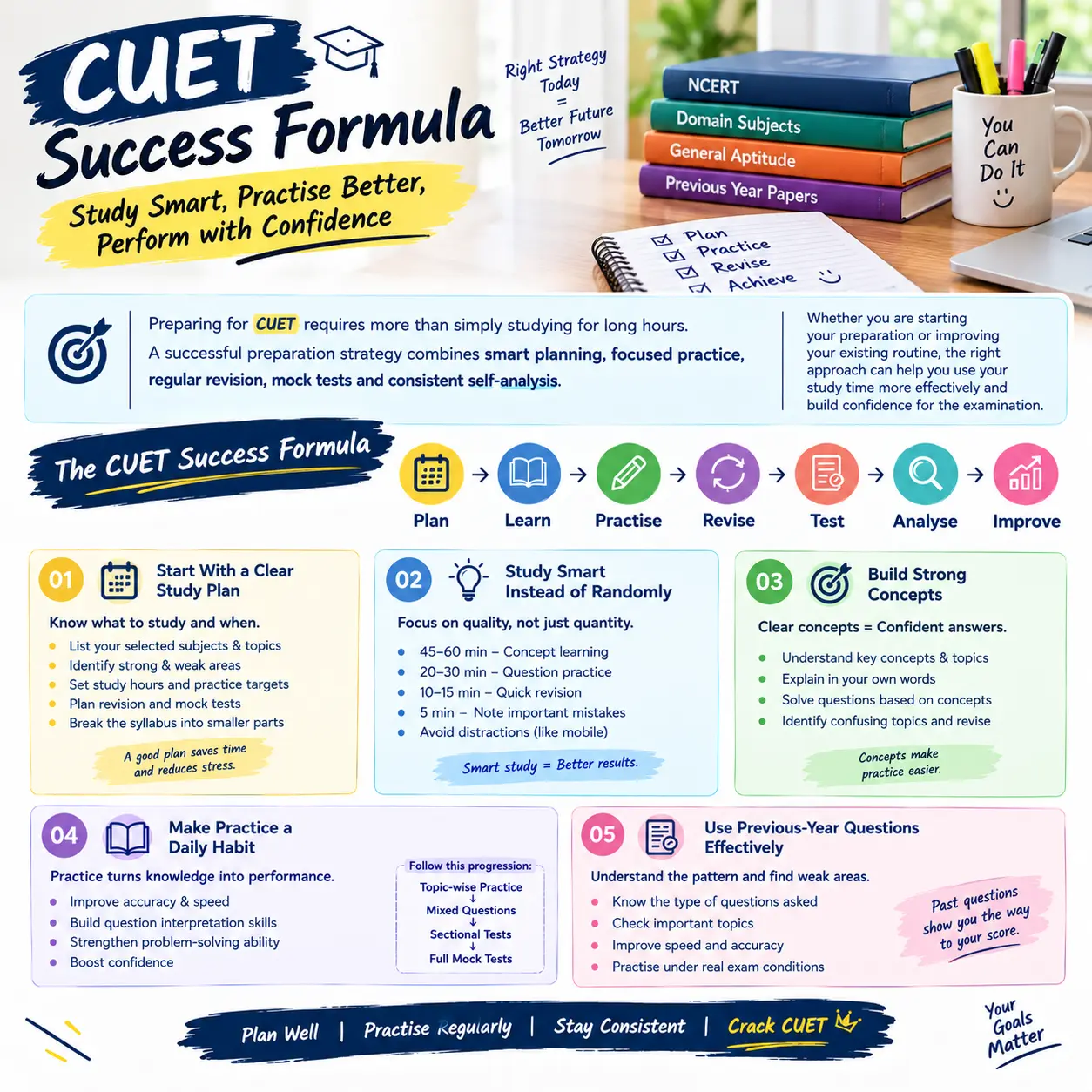
CUET Success Formula: Study Smart, Practise Better, Perform with Confidence
Preparing for CUET requires more than simply studying for long hours. A successful preparation strategy combines smart planning, focused practice, regular revision, mock tests, and consistent self-analysis.
Whether you are starting your preparation or improving your existing routine, the right approach can help you use your study time more effectively and build confidence for the examination.
What Is the CUET Success Formula?
A simple CUET preparation formula is:
Plan → Learn → Practise → Revise → Test → Analyse → Improve
Each step has an important role in your preparation.
Studying without a plan can lead to incomplete topics. Practising without analysis may repeat the same mistakes. Similarly, taking mock tests without revision may not give you the improvement you expect.
The goal is to create a balanced preparation cycle.
1. Start With a Clear Study Plan
Before beginning your preparation, understand what you need to study.
Create a list of:
-
Selected CUET subjects
-
Important topics
-
Strong areas
-
Weak areas
-
Available study hours
-
Practice targets
-
Revision dates
-
Mock-test schedule
Divide your syllabus into smaller sections rather than trying to complete everything at once.
A simple weekly plan can make your preparation more organised and easier to track.
2. Study Smart Instead of Studying Randomly
Long study hours do not always mean effective preparation.
Try to make every study session focused.
For example:
45–60 minutes: Concept learning
20–30 minutes: Question practice
10–15 minutes: Quick revision
5 minutes: Note important mistakes
Keep your phone and other distractions away during focused study sessions.
The objective is to improve the quality of your preparation, not simply increase the number of hours.
3. Build Strong Concepts
Before solving a large number of questions, make sure your basic concepts are clear.
For domain subjects, focus on understanding important concepts and topics from the prescribed syllabus.
While studying, ask yourself:
-
Do I understand this topic?
-
Can I explain it in my own words?
-
Can I solve a question based on it?
-
Which part is still confusing?
If you cannot answer these questions confidently, revise the concept before moving ahead.
4. Make Practice a Daily Habit
Practice converts knowledge into performance.
After learning a topic, solve relevant questions.
Regular practice can help you improve:
-
Accuracy
-
Speed
-
Question interpretation
-
Problem-solving ability
-
Confidence
Instead of solving questions randomly, follow a progression:
Topic-wise Practice → Mixed Questions → Sectional Tests → Full Mock Tests
This allows you to gradually become comfortable with different question types.
5. Use Previous-Year Questions Effectively
Previous-year questions can help you understand the type of questions asked and identify areas that require additional practice.
While solving them, don't focus only on getting the answer.
Analyse:
-
Why was the correct option right?
-
Why were the other options incorrect?
-
Which concept was tested?
-
How much time did you take?
-
Did you make a careless mistake?
Maintain a small PYQ notebook for questions that you found difficult.
6. Revise Before You Forget
Revision should not be left for the final days.
Use short and regular revision sessions.
You can create:
-
Formula sheets
-
Short notes
-
Vocabulary lists
-
Important facts
-
Concept summaries
-
Mistake logs
A useful approach is:
Learn → Revise → Practise → Revisit
Review difficult topics more frequently than topics you already know well.
7. Take Mock Tests Seriously
Mock tests help you practise under exam-like conditions.
Don't wait until the very end of your preparation to start testing yourself.
Begin with topic and sectional tests, then gradually move towards full-length mocks.
After every test, check:
-
Total attempts
-
Correct answers
-
Incorrect answers
-
Unattempted questions
-
Time taken
-
Weak topics
-
Repeated mistakes
The purpose of a mock test is not just to obtain a score. It is to discover how you can improve.
8. Analyse Your Mistakes
Mistake analysis is one of the most important parts of preparation.
Create an error log with categories such as:
Concept Mistake
You did not understand the topic correctly.
Careless Mistake
You knew the concept but made an avoidable error.
Time Management Mistake
You spent too much time on a question.
Reading Mistake
You misunderstood the question or passage.
Guessing Mistake
You selected an option without sufficient reasoning.
Once you identify the reason, take a specific corrective action.
9. Improve Time Management
CUET Course preparation should include timed practice.
While solving questions, keep track of your time.
Gradually learn to:
-
Avoid spending too long on one question
-
Move on when a question becomes time-consuming
-
Return to difficult questions when appropriate
-
Maintain accuracy while increasing speed
The exact approach should be based on the requirements of your selected CUET subjects and the latest official examination information.
10. Balance Boards and CUET Preparation
For Class 12 students, managing board examinations and CUET preparation can be challenging.
Create an integrated schedule wherever possible.
For example:
School/Board Study: Focus on concepts and syllabus coverage
CUET Practice: Objective questions and timed practice
Revision: Revise common topics for both
This approach can help reduce unnecessary duplication of study time.
11. Follow a Simple Daily Routine
A practical daily routine could look like this:
Morning
-
Revise previously studied topics
-
Review formulas, vocabulary, or short notes
Afternoon
-
Study a new topic
-
Complete concept-based learning
Evening
-
Solve practice questions
-
Attempt a short timed test
Night
-
Review mistakes
-
Prepare the next day's study targets
You can adjust this routine according to your school schedule and personal study hours.
12. Track Your Progress
Don't depend only on how many hours you studied.
Track measurable progress such as:
-
Topics completed
-
Questions solved
-
Accuracy percentage
-
Mock-test performance
-
Repeated mistakes
-
Revision completed
For example:
| Week | Questions Practised | Accuracy | Main Focus |
|---|---|---|---|
| Week 1 | 250 | 72% | Concept Building |
| Week 2 | 300 | 77% | Practice |
| Week 3 | 350 | 82% | Accuracy |
| Week 4 | 400 | 86% | Mock Tests |
Your personal progress matters more than comparing every result with another student.
Common CUET Preparation Mistakes
Avoid these common habits:
Studying Without a Plan
Random preparation can leave important topics unfinished.
Focusing Only on Theory
Knowledge needs to be converted into performance through practice.
Ignoring Revision
Without revision, previously learned information can become difficult to recall.
Taking Mocks Without Analysis
A mock test becomes much more useful when you understand your mistakes.
Chasing Speed at the Cost of Accuracy
Fast attempts are not helpful if they regularly lead to incorrect answers.
Leaving Everything for the Last Month
Last-minute preparation can create unnecessary pressure and reduce revision time.
A Simple Weekly CUET Strategy
Monday to Friday
-
Learn new concepts
-
Practise topic-wise questions
-
Revise previous topics
-
Maintain your error log
Saturday
-
Attempt a sectional or full mock test
-
Record your performance
Sunday
-
Analyse mistakes
-
Revise weak topics
-
Reattempt difficult questions
-
Plan the upcoming week
This creates a continuous cycle:
Study → Practise → Test → Analyse → Improve
Read More: https://www.prathamonline.com