
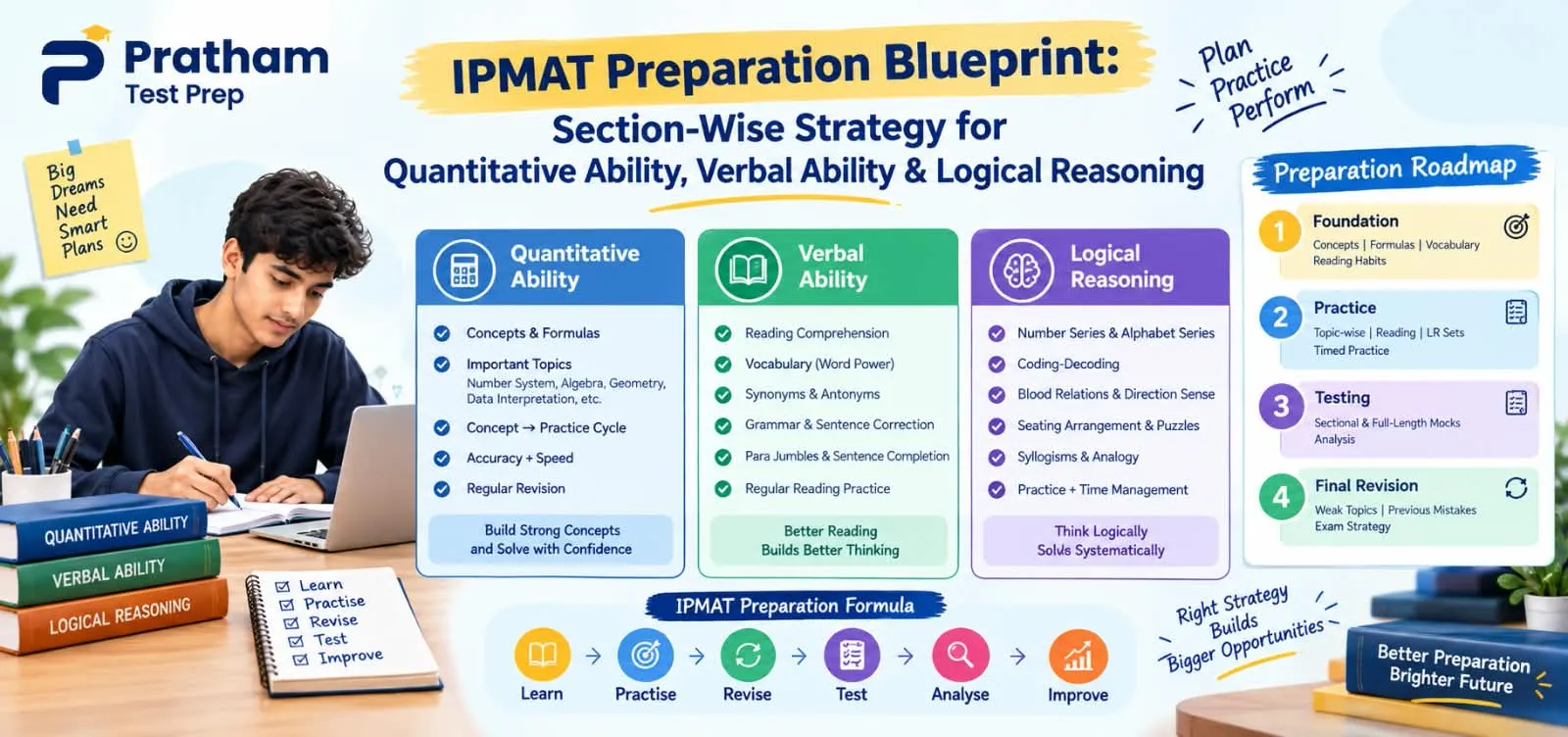
IPMAT Mock Test Strategy: How to Improve Speed, Accuracy & Score with Smart Practice
Mock tests are an important part of IPMAT preparation because they help students practise questions under exam-like conditions. However, simply taking multiple mock tests does not automatically improve performance.
The real benefit comes from attempting, analysing, identifying mistakes, and improving after every test.
A smart IPMAT mock test strategy can help students improve speed, accuracy, time management, question selection, and confidence before the actual examination.
Since IPMAT patterns can differ between institutes, students should first understand the latest pattern of their target institute. For example, IIM Indore's 2026 IPM Aptitude Test had separate Quantitative Ability MCQ, Quantitative Ability Short Answer, and Verbal Ability sections, while IIM Rohtak's 2026 test included Quantitative Ability, Logical Reasoning, and Verbal Ability.
Why Are IPMAT Mock Tests Important?
Mock tests give students an opportunity to apply what they have studied in a timed environment.
Regular mock practice can help you understand:
-
How quickly you solve questions
-
Which topics take more time
-
Where careless mistakes happen
-
Which sections are stronger
-
Which topics need more practice
-
How effectively you manage time
-
Whether you are attempting questions strategically
The purpose of a mock test should not be only to obtain a high score. It should help you understand your current preparation level.
1. Start Mock Tests at the Right Time
Students sometimes make two opposite mistakes.
Some start full-length mocks too early, before building basic concepts. Others wait until the final weeks.
A better approach is to gradually introduce mock tests.
Early Preparation
Focus on:
Concepts → Topic Practice → Sectional Tests
Middle Preparation
Move towards:
Sectional Tests → Mixed Practice → Short Mocks
Advanced Preparation
Focus on:
Full-Length Mocks → Analysis → Revision → Improvement
This allows students to develop both knowledge and test-taking skills.
2. Understand Your Target Exam Pattern
Before taking a mock test, check which institute's examination you are preparing for.
For example, IIM Indore's 2026 test used three sections with 40 minutes allocated to each section. It also specified negative marking for incorrect answers except in the Quantitative Ability Short Answer section.
IIM Rohtak's 2026 IPM AT had 40 questions each in Quantitative Ability, Logical Reasoning, and Verbal Ability within a 120-minute test, with 4 marks for a correct answer and a 1-mark deduction for an incorrect answer.
Therefore, your mock should match the latest pattern of the institute you are targeting.
3. Create an Exam-Like Environment
Do not treat every mock test like casual practice.
Before starting:
-
Keep your phone away.
-
Sit at a proper desk.
-
Keep only permitted materials nearby.
-
Set the exact time limit.
-
Avoid unnecessary breaks.
-
Attempt the test in one sitting whenever possible.
The goal is to make the practice environment similar to the actual examination.
4. Focus on Accuracy Before Speed
Many students try to increase their speed immediately.
A better approach is:
Step 1: Build Accuracy
Understand the question and solve it correctly.
Step 2: Improve Efficiency
Look for shorter and better approaches.
Step 3: Increase Speed
Practise under time limits.
Speed becomes more useful when it is supported by accuracy.
5. Learn Question Selection
One of the most important mock-test skills is knowing which questions to attempt first.
You may encounter:
-
Easy questions
-
Moderate questions
-
Time-consuming questions
-
Difficult questions
-
Questions from unfamiliar topics
Do not spend too much time on a single question simply because you have started solving it.
A useful approach is:
Recognise → Estimate → Attempt → Move On
If a question is taking significantly longer than expected, mark it for review and continue when the test format allows it.
6. Analyse Every Mock Test
This is perhaps the most important part of your mock-test strategy.
After completing a test, do not immediately move to the next one.
Analyse your performance.
Check:
-
Total score
-
Correct answers
-
Incorrect answers
-
Unattempted questions
-
Time spent
-
Questions taking too long
-
Conceptual mistakes
-
Calculation mistakes
-
Reading mistakes
-
Guessing mistakes
Your analysis should answer one simple question:
“Why did I lose marks?”
7. Maintain an IPMAT Error Log
Create an error log after every mock test.
A simple format can be:
| Question | Topic | Mistake Type | Reason | Correct Approach |
|---|---|---|---|---|
| Q12 | Algebra | Concept | Formula confusion | Revise concept |
| Q24 | RC | Reading | Misread passage | Improve comprehension |
| Q31 | LR | Time | Took too long | Practise similar sets |
Review this notebook regularly.
If the same mistake appears multiple times, it becomes a priority topic.
8. Analyse Correct Answers Too
Do not analyse only incorrect answers.
Sometimes students get the correct answer through guessing or by spending too much time.
For example:
Correct Answer + 4 minutes = Needs Improvement
Correct Answer + 1 minute = Efficient
Therefore, mark questions where:
-
You guessed the answer.
-
You were unsure.
-
You used a long method.
-
You took too much time.
This provides a more accurate picture of your preparation.
9. Track Speed and Accuracy
Maintain a simple record after every mock.
| Mock | Accuracy | Time Management | Major Weakness |
|---|---|---|---|
| Mock 1 | 68% | Needs Work | Quant |
| Mock 2 | 72% | Improving | LR |
| Mock 3 | 76% | Good | RC |
The exact numbers are less important than identifying the direction of your improvement.
Your objective should be to gradually improve both accuracy and efficiency.
10. Don't Take Too Many Mocks Without Analysis
More mock tests do not automatically mean better preparation.
Suppose a student takes 10 mocks but does not analyse mistakes.
Another student takes 5 mocks and carefully reviews every incorrect and time-consuming question.
The second approach can provide more useful learning from each test.
Follow:
Mock → Analysis → Practice → Revision → Next Mock
rather than:
Mock → Score → Next Mock
11. Section-Wise Mock Practice
Full-length mocks are important, but sectional tests can help identify specific weaknesses.
Quantitative Ability
Practise:
-
Arithmetic
-
Algebra
-
Number System
-
Geometry
-
Data Interpretation
-
Other relevant topics
Verbal Ability
Practise:
-
Reading Comprehension
-
Vocabulary
-
Grammar
-
Sentence-based questions
-
Other relevant language topics
Logical Reasoning
For institutes where LR is included, practise:
-
Series
-
Arrangements
-
Puzzles
-
Coding-Decoding
-
Logical deductions
-
Other relevant reasoning topics
The exact areas should be aligned with the latest official pattern and syllabus of your target institute.
12. Improve Time Management Through Mocks
Time management cannot be developed effectively by reading about it. It needs practice.
During mocks, track:
Total Time → Section Time → Question Time
After the test, identify:
-
Which section consumed the most time?
-
Which questions caused delays?
-
Did you spend too long on difficult questions?
-
Did you leave easy questions because of poor time management?
Use this information in your next mock.
13. Use the 3-Level Question Strategy
During practice, classify questions into three levels:
Level 1 – Easy
Questions you can solve quickly and confidently.
Level 2 – Moderate
Questions requiring some calculation or reasoning.
Level 3 – Difficult
Questions requiring significant time or advanced thinking.
During mock analysis, check whether you are spending too much time on Level 3 questions while easier questions remain unanswered.
This can improve question selection.
14. Review Your Weak Topics
After several mocks, patterns will begin to appear.
For example:
Mock 1: Percentage mistakes
Mock 2: Percentage mistakes
Mock 3: Percentage mistakes
This indicates that percentage needs focused revision.
Do not simply take another mock.
Instead:
Identify Weak Topic → Revise Concept → Solve 20–30 Questions → Take Sectional Test → Recheck Performance
This turns mock-test analysis into actual improvement.
15. Create a Weekly Mock-Test Routine
A balanced weekly routine could look like this:
Monday–Thursday
Concept building and topic-wise practice.
Friday
Sectional tests and revision.
Saturday
Full-length mock test.
Sunday
Detailed mock analysis and weak-topic practice.
Students can adjust this routine according to their preparation stage and target exam.
16. Avoid These Common Mock-Test Mistakes
Checking the Score Only
A score does not explain why you made mistakes.
Taking Tests Without Revision
If the same weak topics keep appearing, revise them before taking another mock.
Guessing Too Many Questions
If the exam has negative marking, random guessing can reduce your score. IIM Rohtak's 2026 IPM AT, for example, specified a one-mark penalty for an incorrect answer.
Ignoring Time-Consuming Questions
A correct answer that takes excessive time can still indicate an inefficient approach.
Comparing Every Score With Others
Focus on your own improvement and identify what needs to change.
Changing Strategy After Every Mock
Do not completely change your approach because of one poor score. Look for patterns across multiple tests.
17. How Many Mock Tests Should You Take?
There is no universal number that works for every student.
The focus should be on quality and analysis.
A student who is beginning mock practice may start with fewer tests and more analysis.
As the examination approaches, students can gradually increase the frequency of full-length tests while continuing revision and error analysis.
The important cycle remains:
Attempt → Analyse → Improve → Reattempt
18. Final Week Mock-Test Strategy
During the final stage of preparation, avoid turning every day into a mock-test day.
Use a balanced approach:
-
Take realistic full-length mocks.
-
Analyse mistakes.
-
Revise weak topics.
-
Review formulas.
-
Revise vocabulary.
-
Revisit your error log.
-
Practise time management.
-
Maintain a consistent routine.
The final stage should focus on strengthening preparation rather than creating unnecessary pressure.
IPMAT Mock Test Improvement Formula
A simple formula to remember is:
TEST → ANALYSE → IDENTIFY → PRACTISE → REVISE → RETEST
TEST
Take the mock under exam-like conditions.
ANALYSE
Review every important mistake.
IDENTIFY
Find repeated weak areas.
PRACTISE
Solve targeted questions.
REVISE
Review concepts and mistakes.
RETEST
Check whether your performance has improved.
This creates a continuous improvement cycle.
Final Thoughts
An IPMAT mock test is more than a practice paper. It is a tool for understanding your preparation and improving your exam strategy.
The biggest benefit comes when students use every test to identify mistakes, improve accuracy, manage time, and make better decisions about which questions to attempt.
Don't just take more mocks. Learn more from every mock.
With consistent practice, detailed analysis, targeted revision, and a clear focus on speed and accuracy, students can make their IPMAT preparation more structured and effective.
Always check the latest official admission information for your target institute because IPMAT patterns and selection procedures can differ across institutes. IIM Indore and IIM Rohtak are examples of institutes with different 2026 aptitude-test structures.
Read More: https://prathamonline.com/