
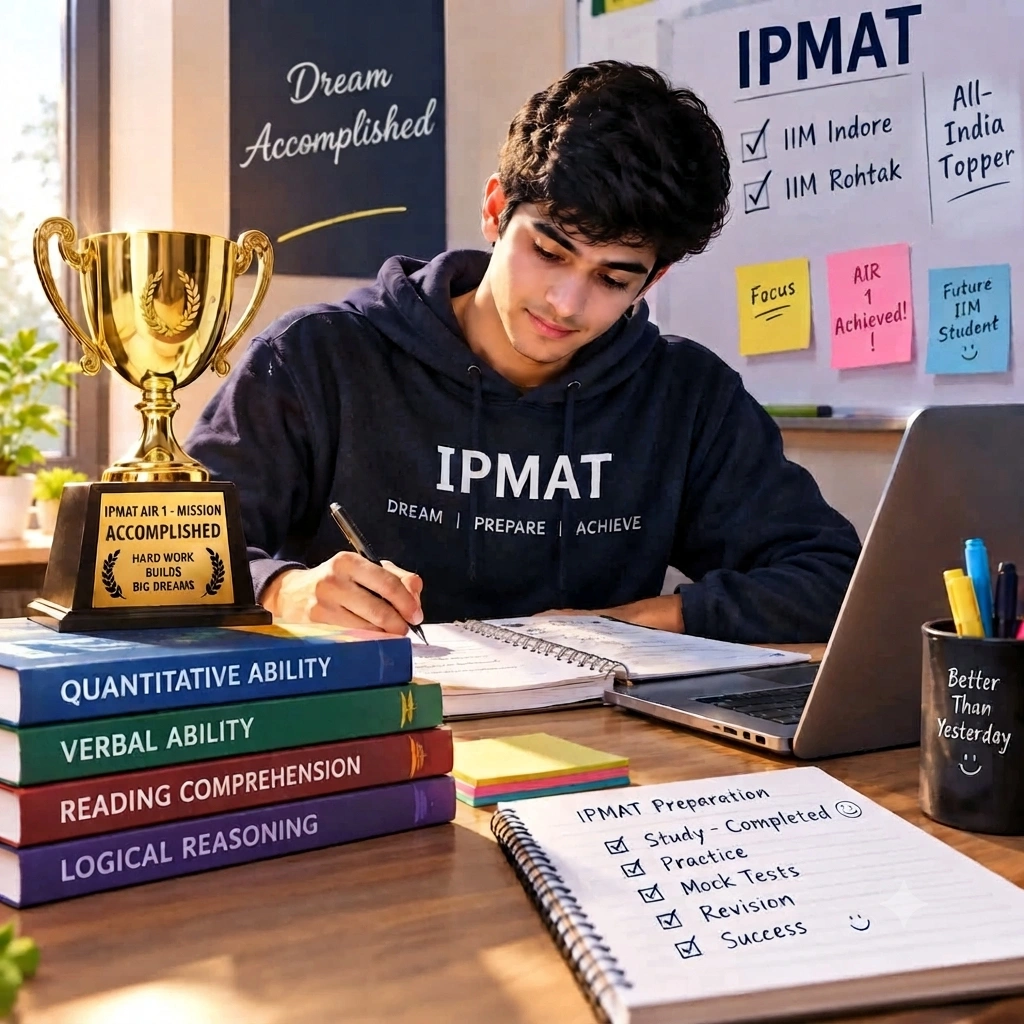
IPMAT Study Resources: Books, Mock Tests, PYQs & Preparation Material
Preparing for IPMAT requires the right combination of study material, practice questions, mock tests, previous-year papers, revision resources, and proper guidance. Instead of collecting too many books and PDFs, students should build a focused preparation system that supports concept learning and regular practice.
A well-organised set of IPMAT study resources can help students understand important topics, improve accuracy, manage time, and track their preparation progress.
1. Concept-Based IPMAT Study Material
Strong fundamentals are the starting point of IPMAT preparation. Students should use structured study material for the major areas of preparation, including:
-
Quantitative Ability
-
Verbal Ability
-
Reading Comprehension
-
Logical Reasoning
Concept-based material helps students understand topics step by step before moving to advanced practice.
For Quantitative Ability, focus on understanding formulas and their applications. For Verbal Ability and Reading Comprehension, develop grammar, vocabulary, and reading skills. Logical Reasoning requires regular exposure to different question types and patterns.
The goal should be concept clarity before speed.
2. Topic-Wise Practice Questions
Once the concepts are clear, regular practice becomes important.
Students can divide practice into:
-
Topic-wise questions
-
Sectional practice
-
Mixed-question sets
-
Timed practice sessions
Topic-wise practice helps identify weak areas, while sectional practice helps students become comfortable with solving multiple questions within a limited time.
Keep an error log while practising. Record questions that were incorrect, questions that took too much time, and concepts that need revision.
3. IPMAT Mock Tests
Mock tests provide an opportunity to practise in a time-bound environment. They can help students understand their current preparation level and identify areas that require more attention.
While attempting an IPMAT mock test:
-
Follow the actual time limit.
-
Avoid unnecessary breaks.
-
Attempt questions strategically.
-
Track your accuracy.
-
Record questions that consumed excessive time.
After the test, spend time analysing your performance instead of looking only at the final score.
4. Previous-Year Questions and Sample Papers
Previous-year questions are an important part of IPMAT 2027 preparation because they provide practical exposure to the types of questions asked in earlier examinations.
Solving past papers can help students understand:
-
Question patterns
-
Difficulty level
-
Frequently tested concepts
-
Time requirements
-
Personal strengths and weaknesses
Students can first solve previous-year questions without looking at solutions and then analyse every incorrect or unattempted question.
Sample papers can also be used after completing individual topics to test overall preparation.
5. Revision Resources
Revision becomes much easier when students maintain short and organised resources throughout their preparation.
Useful revision resources include:
Formula Sheets
Maintain important formulas and shortcuts for Quantitative Ability.
Vocabulary Lists
Write down new words, meanings, synonyms, antonyms, and examples.
Short Notes
Summarise difficult concepts in your own words.
Error Logs
Record repeated mistakes from practice questions and mock tests.
These resources can save time during the final stages of preparation and make quick revision more effective.
6. Structured IPMAT Coaching
Self-study can be supported by structured coaching when students need a planned learning path, regular practice, doubt support, and performance guidance.
A structured preparation programme can bring together:
-
Concept classes
-
Study material
-
Practice questions
-
Mock tests
-
Previous-year questions
-
Doubt solving
-
Performance analysis
-
Revision support
The purpose of coaching should be to make preparation more organised rather than simply increasing the amount of study material.
How to Use IPMAT Resources Effectively
Having good resources is only the first step. Students also need to know when and how to use them.
A simple preparation cycle can be:
Learn → Practise → Test → Analyse → Revise → Repeat
Start with concept-based study material. Follow it with topic-wise practice. Once a topic is comfortable, attempt sectional questions and eventually full-length mock tests.
After every test, identify mistakes and revise the related concepts.
This approach is more useful than switching between multiple books, websites, and PDFs without completing any of them.
Build Your Personal IPMAT Resource Kit
Instead of collecting dozens of resources, create a compact preparation system containing:
-
One reliable source for concepts
-
Topic-wise practice questions
-
Previous-year papers
-
Regular mock tests
-
Formula sheets
-
Vocabulary notes
-
Error log
-
Revision notes
A focused resource kit makes preparation easier to manage and helps students remain consistent.
Prepare for IIM Indore and IIM Rohtak
Students preparing for IPMAT should also understand that different institutes can have different examination patterns and admission processes. Therefore, preparation resources should be selected according to the target institute and the latest official information.
Students targeting IIM Indore and IIM Rohtak should regularly check the respective official admission information for the latest eligibility criteria, exam pattern, dates, and selection process.
Explore IPMAT Preparation at PRATHAM
Students looking for structured IPMAT preparation, study material, practice questions, mock tests, and preparation guidance can explore PRATHAM's IPM programmes.
A planned preparation approach can help students combine learning, practice, testing, revision, and performance analysis in one organised journey.
Final Thoughts
The right IPMAT study resources can make preparation more organised and productive. Concept-based material builds the foundation, practice questions develop problem-solving ability, mock tests improve exam readiness, previous-year papers provide real exam exposure, and revision resources help retain important concepts.
Remember that collecting resources is not preparation. Using the right resources consistently is what matters.
Choose your resources carefully, follow a structured routine, analyse your mistakes, and keep improving throughout your IPMAT preparation journey.
Read More: https://www.prathamonline.com/