
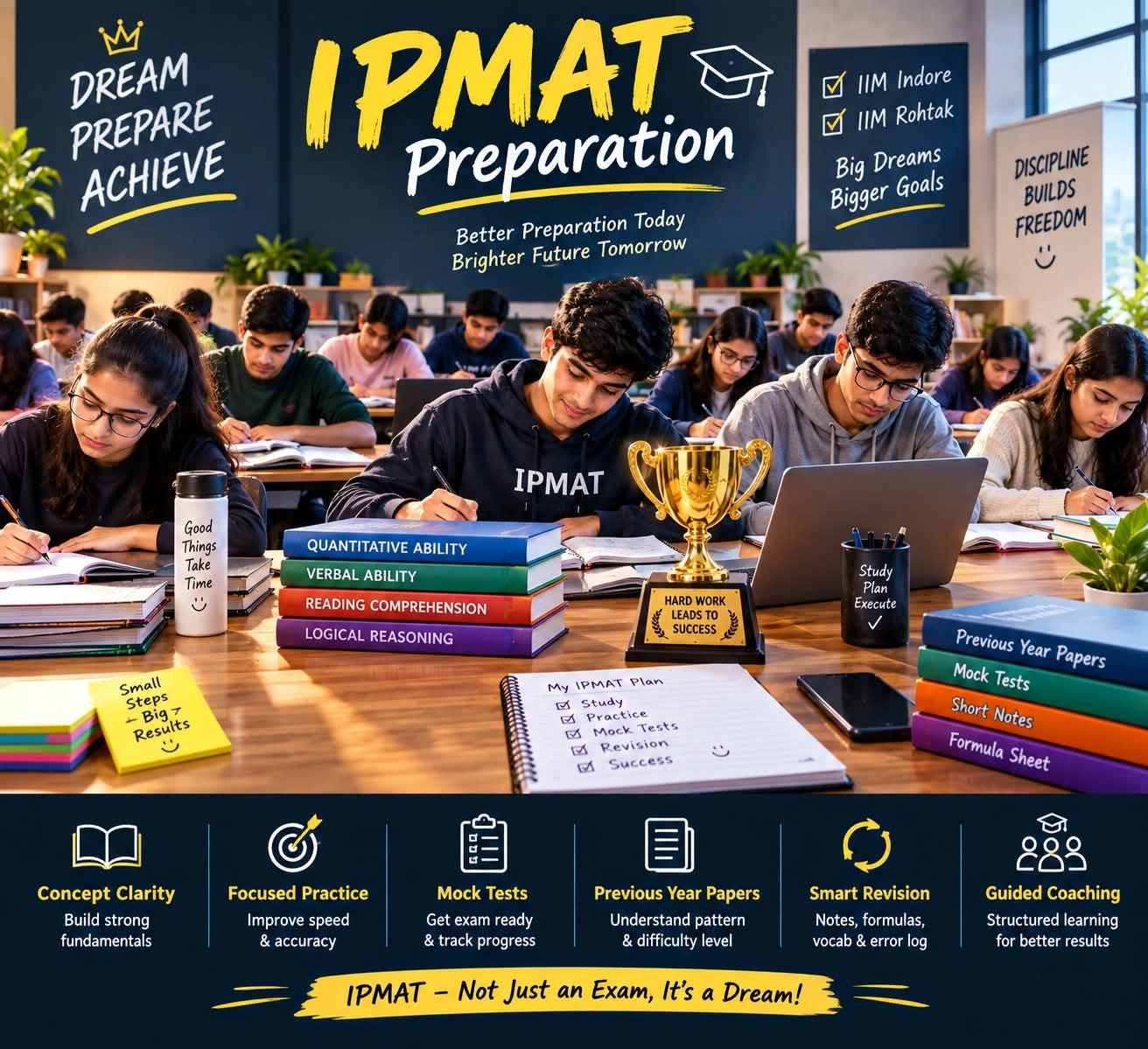
IPMAT Preparation Strategy: Study Plan, Mock Tests & Success Tips
Preparing for the Integrated Programme in Management Aptitude Test (IPMAT) requires a combination of strong fundamentals, regular practice, effective revision, and proper time management. Students preparing for IPMAT should focus on understanding concepts, improving speed and accuracy, and regularly evaluating their performance.
A structured IPMAT preparation strategy can help students organise their studies and prepare systematically for the examination.
Understand the IPMAT Exam Requirements
Before starting preparation, students should understand the examination pattern, sections, syllabus, and admission requirements relevant to the IPMAT programme they are targeting.
Having a clear understanding of the examination helps students identify the subjects they need to prepare and create a study schedule accordingly.
Build Strong Concepts
Concept clarity is an important part of IPMAT preparation. Students should focus on strengthening their fundamentals before moving towards advanced practice.
For quantitative preparation, students should revise important mathematical concepts and learn how to apply them to different types of questions. Strong fundamentals can make problem-solving more efficient.
Prepare Quantitative Ability
Quantitative Ability requires regular practice and a clear understanding of mathematical concepts. Students should practise topics such as arithmetic, algebra, geometry, percentages, ratios, averages, and other relevant areas according to the examination syllabus.
Regular practice can help students improve their calculation speed and accuracy.
Improve Verbal Ability and Reading Comprehension
Verbal Ability and Reading Comprehension require consistent reading and language practice. Students can read newspapers, editorials, articles, and quality books to improve comprehension and vocabulary.
Regular reading can also help students become more comfortable with lengthy passages and improve their ability to identify important information quickly.
Practise Logical Reasoning
Logical reasoning questions require students to understand relationships, patterns, statements, and logical connections. Regular practice can help students develop a systematic approach to solving these questions.
Students should analyse difficult questions after practice and understand the reasoning behind the correct answer.
Solve Previous Year Papers
Previous year papers can help students become familiar with the examination pattern and understand the types of questions that may appear.
Students should solve previous year papers under timed conditions and analyse their performance afterwards. This can help them identify frequently challenging topics and areas that require additional practice.
Take Regular Mock Tests
Mock tests are an important part of IPMAT 2027 preparation. They provide an opportunity to practise the complete examination under time constraints.
Students should use mock tests to evaluate their speed, accuracy, time management, and overall preparation. Analysing mistakes after each test is just as important as taking the test itself.
Maintain Short Notes and Formula Sheets
Short notes can make revision more efficient. Students can maintain separate notes for important formulas, vocabulary, concepts, shortcuts, and commonly made mistakes.
These notes can be particularly useful during revision when students need to review important information within a limited amount of time.
Improve Speed and Accuracy
IPMAT preparation requires students to solve questions efficiently while maintaining accuracy. Students should practise timed question sets and gradually work on improving their solving speed.
Instead of attempting questions quickly without understanding them, students should focus on developing an approach that balances speed and accuracy.
Track Your Preparation Progress
Students should regularly track their preparation progress. A simple tracker can include completed topics, practice questions, previous year papers, mock-test scores, accuracy levels, and topics that need revision.
Monitoring progress can help students understand their strengths and identify areas that require more attention.
Follow a Consistent Revision Plan
Revision should be included throughout the preparation journey. Students should regularly revisit formulas, vocabulary, concepts, and questions that they previously found difficult.
An error log can also be maintained to record mistakes from practice sessions and mock tests. Reviewing these mistakes can help students avoid repeating them.
Stay Consistent With Your Preparation
Consistent preparation is more useful than relying on last-minute study sessions. Students should follow a realistic daily or weekly routine that includes concept learning, question practice, revision, and mock tests.
Small and regular improvements can gradually build confidence and improve overall preparation.
Conclusion
An effective IPMAT preparation strategy should combine concept clarity, quantitative practice, verbal ability, reading comprehension, logical reasoning, previous year papers, mock tests, and smart revision.
Students should create a practical study plan according to their preparation level and regularly analyse their performance. With consistent practice, focused revision, and proper time management, students can approach IPMAT preparation in a more organised and confident manner.
Read More: https://www.prathamonline.com/