
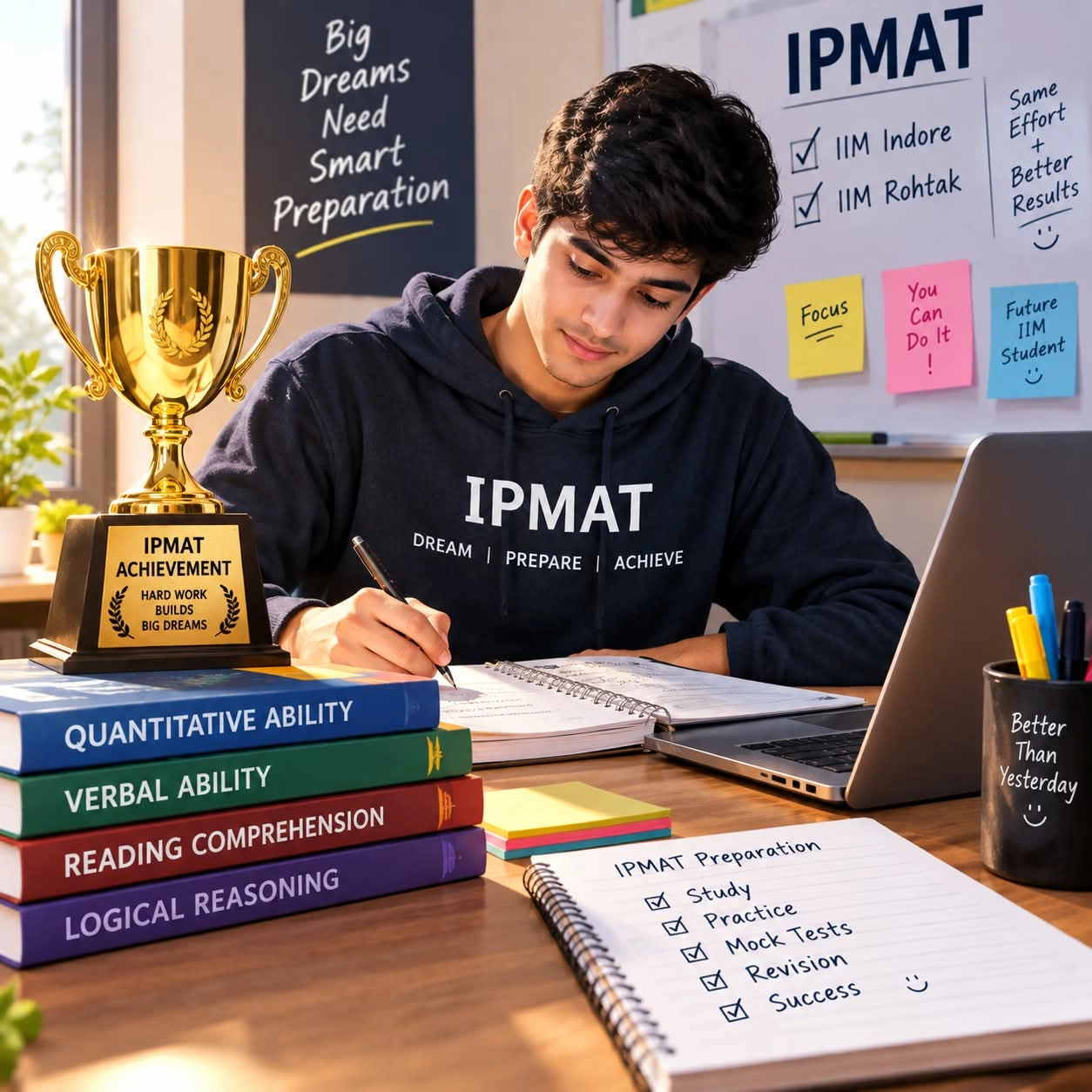
IPMAT Success Roadmap: Subject-Wise Preparation Plan for IIM Aspirants
The Integrated Programme in Management Aptitude Test (IPMAT) is an important entrance examination for students who want to pursue an integrated management programme after Class 12. A successful preparation journey requires more than just studying the syllabus. Students need strong concepts, regular practice, mock tests, previous-year papers, smart revision, and consistent time management.
With the right preparation strategy, students can build confidence and improve their performance across different sections of the exam.
Understand the IPMAT Preparation Requirements
Before starting preparation, students should understand the major areas tested in IPMAT. The exact pattern and selection process can vary by institute and admission year, so candidates should always check the latest official admission information.
For example, IIM Rohtak's 2026 IPM Aptitude Test includes Quantitative Ability, Logical Reasoning, and Verbal Ability, with 40 questions in each section and a total test duration of 120 minutes. The institute also uses a Personal Interview as part of its selection process.
This makes it important to prepare both aptitude skills and communication abilities.
1. Quantitative Ability
Quantitative Ability is one of the key areas of IPMAT preparation. Students should focus on building mathematical fundamentals before moving to advanced questions.
Important areas to practise include:
-
Number System
-
Percentages
-
Profit and Loss
-
Ratio and Proportion
-
Averages
-
Time, Speed and Distance
-
Time and Work
-
Algebra
-
Geometry
-
Mensuration
-
Data Interpretation
How to Prepare for Quantitative Ability
Start with basic concepts and formulas. Solve easy questions first and gradually move towards moderate and difficult problems.
Maintain a formula sheet containing important concepts and shortcuts. Revise it regularly instead of trying to memorise everything at the last moment.
Most importantly, focus on understanding the method behind a question rather than simply remembering an answer.
2. Verbal Ability
A strong command of English can help students handle verbal questions more effectively.
Preparation should include:
-
Vocabulary building
-
Grammar
-
Sentence correction
-
Para jumbles
-
Fill in the blanks
-
Sentence completion
-
Synonyms and antonyms
-
Vocabulary-based questions
How to Improve Verbal Ability
Read English newspapers, magazines, editorials, and quality articles regularly. Maintain a vocabulary notebook and revise newly learned words.
Instead of learning hundreds of words randomly, focus on understanding their meaning and usage in sentences.
Daily reading can also improve comprehension speed and help students become more comfortable with unfamiliar topics.
3. Reading Comprehension
Reading Comprehension is closely connected with both vocabulary and reading ability.
Students should practise passages from different areas such as:
-
Business
-
Economics
-
History
-
Science
-
Technology
-
Social issues
-
Current affairs
How to Practise Reading Comprehension
Start with shorter passages and gradually move towards longer and more complex ones.
While reading, focus on:
-
Main idea
-
Author's purpose
-
Important facts
-
Tone of the passage
-
Inference
-
Supporting arguments
Try to understand the passage instead of reading every sentence repeatedly. With regular practice, students can gradually improve both speed and accuracy.
4. Logical Reasoning
Logical Reasoning tests a student's ability to identify patterns, relationships, and logical connections.
Important areas may include:
-
Series
-
Coding-decoding
-
Blood relations
-
Direction sense
-
Seating arrangements
-
Puzzles
-
Syllogisms
-
Statements and conclusions
-
Data-based reasoning
How to Prepare for Logical Reasoning
Begin with basic reasoning concepts and solve questions regularly. Once the basics are clear, practise timed sets.
Keep track of the questions where you make repeated mistakes. This helps identify weak areas and prevents the same errors from occurring in future tests.
Build a Structured IPMAT Study Plan
A good study plan should divide preparation into different stages rather than trying to complete everything at once.
Stage 1: Build Your Foundation
Start by understanding the syllabus and identifying your strong and weak subjects.
Focus on:
-
Basic concepts
-
Important formulas
-
Grammar fundamentals
-
Reading habits
-
Basic reasoning techniques
The objective at this stage should be concept clarity.
Stage 2: Focused Practice
Once the fundamentals are clear, increase the number of questions you solve every day.
Create separate practice sessions for:
-
Quantitative Ability
-
Verbal Ability
-
Reading Comprehension
-
Logical Reasoning
Maintain an error notebook and write down important mistakes, formulas, shortcuts, and concepts that require revision.
Stage 3: Previous-Year Papers
Previous-year papers help students understand the style and difficulty of questions.
While solving them, try to identify:
-
Frequently tested concepts
-
Question types
-
Time-consuming topics
-
Common mistakes
-
Areas requiring additional practice
Do not simply check your score. Analyse every incorrect and skipped question.
Make Mock Tests a Regular Part of Preparation
Mock tests are an important part of IPMAT preparation because they help students practise under exam-like conditions.
Start with topic-wise tests and gradually move towards complete mock papers.
During every mock test, track:
-
Total score
-
Correct answers
-
Incorrect answers
-
Unattempted questions
-
Time spent
-
Questions that took too long
The purpose of a mock test is not only to measure your score. It is also to identify what needs improvement.
Analyse Every Mock Test
Mock analysis can make your preparation more effective.
After completing a test, divide your mistakes into categories:
Concept Mistake:
You did not understand the underlying concept.
Calculation Mistake:
You knew the concept but made an arithmetic error.
Time Management Mistake:
You spent too much time on a particular question.
Reading Mistake:
You misunderstood the question or passage.
Guessing Mistake:
You selected an option without sufficient confidence.
This analysis gives you a clear idea of where your preparation needs attention.
Smart Revision Strategy
Revision should continue throughout your preparation.
Create short revision notes for:
-
Important formulas
-
Grammar rules
-
Vocabulary
-
Reasoning concepts
-
Frequently repeated mistakes
-
Difficult questions
Use your formula sheets and short notes for quick revision before practice sessions and mock tests.
Avoid waiting until the final weeks to revise the entire syllabus.
Develop Better Time Management
Time management is essential during aptitude-based entrance exams.
During practice, learn to distinguish between:
-
Questions you can solve quickly
-
Questions that require more calculation
-
Questions that are taking too much time
-
Questions that should be attempted later
The goal is to develop a balanced approach where you maintain both accuracy and speed.
Prepare for IIM Indore and IIM Rohtak
Students targeting leading IPM programmes should understand the admission requirements of their preferred institutes.
IIM Rohtak's 2026–31 IPM admission process includes the IPM Aptitude Test followed by Personal Interview for shortlisted candidates. Its final merit calculation includes the aptitude test, Personal Interview, and Class 10 and Class 12 academic performance.
IIM Indore also conducts the IPM Aptitude Test as part of its five-year Integrated Programme in Management admission process. The official IIM Indore admissions page provides the latest information for the 2026–31 batch.
Since admission rules, dates, eligibility criteria, and selection weightages can change, students should verify the latest information directly from the respective institute before applying.
Create a Consistent Daily Routine
Consistency is more important than studying for long hours occasionally.
A daily routine can include:
Quantitative Ability: Concept learning + problem solving
Verbal Ability: Vocabulary + grammar
Reading Comprehension: Daily reading + passage practice
Logical Reasoning: Reasoning sets + timed practice
Revision: Formula and mistake review
Mock Practice: Sectional or full-length tests according to your preparation stage
Adjust the schedule according to your strengths, weaknesses, school workload, and available preparation time.
Keep Improving Every Week
Your preparation should show measurable improvement over time.
At the end of every week, review:
-
What topics were completed?
-
Which topics are still weak?
-
How many questions were solved?
-
What was the mock-test performance?
-
Which mistakes were repeated?
-
What should be improved next week?
This simple weekly review can help keep your preparation organised.
Stay Focused on the Bigger Goal
IPMAT preparation can take time, and improvement may not happen immediately.
Remember:
Big Dreams Need Smart Preparation.
Hard Work Builds Big Dreams.
Better Than Yesterday.
Instead of comparing your preparation with other students, focus on improving your own performance. A small improvement in accuracy, speed, vocabulary, or problem-solving ability every week can make your preparation stronger.
Final Thoughts
A successful IPMAT preparation strategy combines concept clarity, focused practice, reading, logical thinking, mock tests, previous-year papers, revision, and regular performance analysis.
Start with the basics, practise consistently, analyse your mistakes, and gradually increase the difficulty of your preparation.
With a structured roadmap and disciplined preparation, students can work towards their goal of pursuing an integrated management programme at institutes such as IIM Indore and IIM Rohtak.
Plan your preparation. Practise with purpose. Analyse your performance. Keep improving.
Read More: https://www.prathamonline.com/