
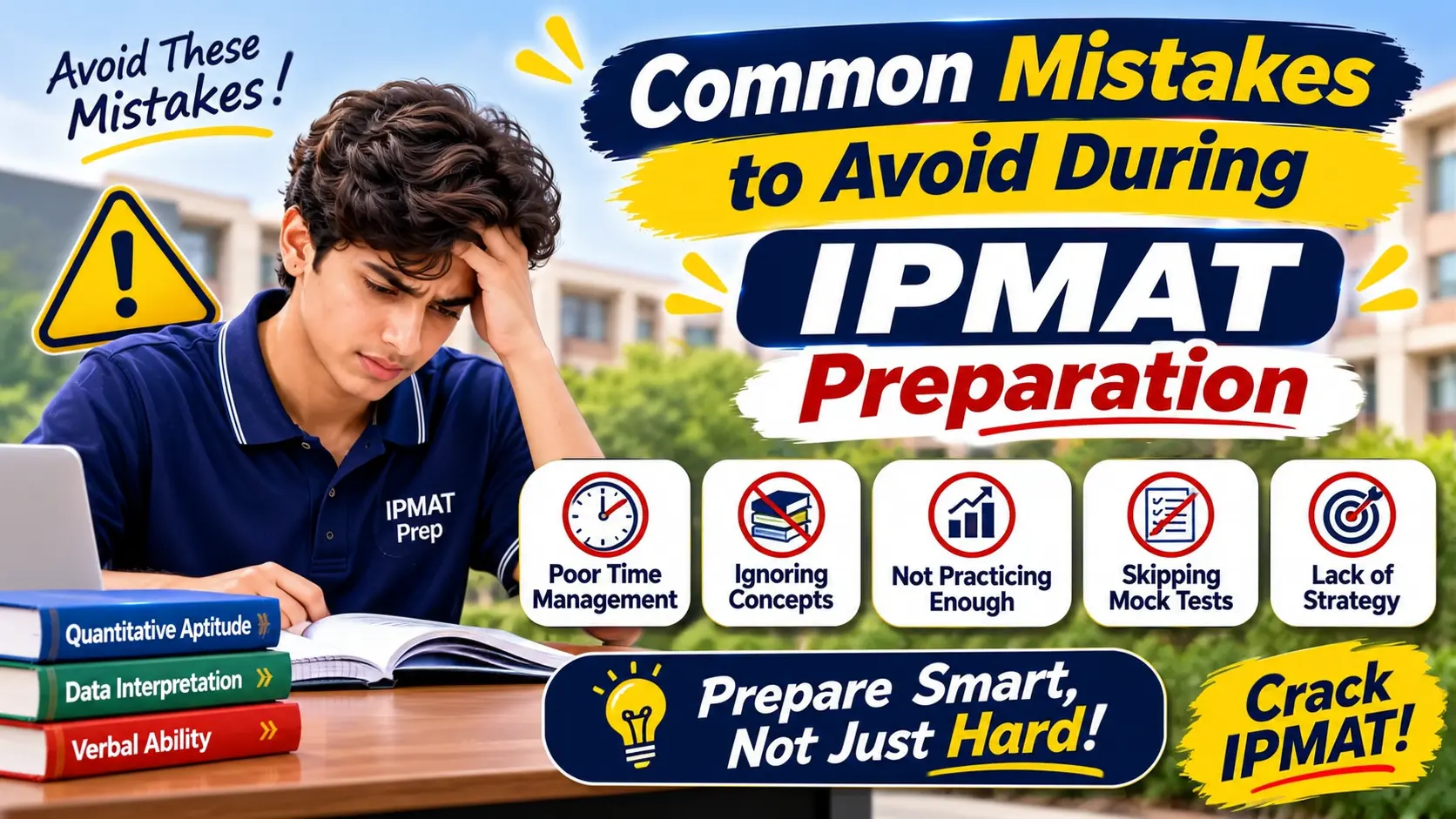
Common Mistakes to Avoid During IPMAT Preparation
IPMAT is one of the popular entrance examinations for students aspiring to pursue an integrated management programme after Class 12. Preparing for this examination requires conceptual clarity, consistent practice, time management and a well-planned strategy.
However, many aspirants make avoidable mistakes that affect their preparation and examination performance. Understanding these mistakes early can help students prepare more effectively and improve their chances of achieving their target scores.
1. Starting Preparation Without Understanding the Syllabus
One of the biggest mistakes is beginning preparation without understanding the examination pattern and syllabus. Students may spend time studying topics that are less relevant to their target examination while overlooking important concepts.
How to avoid it: Review the latest official examination pattern and syllabus for each institute. Create a topic-wise checklist and organise your preparation accordingly.
2. Ignoring Quantitative Aptitude Fundamentals
Quantitative Aptitude requires strong mathematical fundamentals and regular problem-solving practice. Students who directly attempt difficult questions without understanding basic concepts often struggle with accuracy.
How to avoid it: Start with arithmetic, algebra, percentages, ratios, averages and other relevant fundamentals. Gradually move towards advanced and timed questions.
3. Neglecting Verbal Ability
Many students concentrate heavily on Mathematics and ignore English preparation. This can affect performance in reading comprehension, vocabulary and verbal reasoning questions.
How to avoid it: Develop a daily reading habit. Practise comprehension passages, grammar exercises, vocabulary and sentence-based questions.
4. Taking Mock Tests Without Analysing Them
Mock tests are essential for understanding examination difficulty and time management. However, attempting tests without reviewing mistakes reduces their effectiveness.
How to avoid it: After every mock test, identify incorrect answers, weak topics, calculation errors and questions that consumed excessive time.
5. Poor Time Management
Spending too much time on a single difficult question can prevent students from attempting easier questions. Effective time management is therefore an important part of IPMAT preparation.
How to avoid it: Practise timed sectional tests and learn when to move on from a question. Develop a question-selection strategy based on the examination format.
6. Following an Unrealistic Study Timetable
Some students create schedules that require excessive study hours without considering school, breaks, revision and personal commitments. Such routines are difficult to maintain.
How to avoid it: Create realistic daily targets. Divide preparation into manageable sessions and maintain a consistent revision schedule.
7. Using Too Many Study Materials
Collecting multiple books, online courses and question banks can create confusion. Students may spend more time switching between resources than actually practising.
How to avoid it: Select a limited number of reliable resources and complete them systematically before adding new material.
8. Ignoring Revision
Learning a concept once does not guarantee that you will remember it during the examination. Without revision, students may repeatedly make the same mistakes.
How to avoid it: Maintain formula sheets, vocabulary lists and an error notebook. Revise these regularly and practise previously incorrect questions.
9. Comparing Your Preparation With Other Students
Every aspirant has a different academic background, learning speed and preparation level. Comparing your progress with others can create unnecessary pressure.
How to avoid it: Track your own performance through mock tests and weekly targets. Focus on improving your accuracy and consistency.
10. Ignoring the Importance of Sleep and Breaks
Studying continuously without sufficient rest can affect concentration, memory and productivity.
How to avoid it: Follow a balanced routine with short breaks, adequate sleep and physical activity.
How to Build an Effective IPMAT Preparation Strategy
- Understand the latest examination pattern.
- Prepare a subject-wise study timetable.
- Strengthen Quantitative Aptitude fundamentals.
- Practise Verbal Ability regularly.
- Take sectional and full-length mock tests.
- Analyse mistakes and revise weak topics.
- Track weekly preparation progress.
How PRATHAM Test Prep Can Support Your IPMAT Preparation
Having a structured learning approach can make IPMAT preparation more organised. Proper guidance, regular practice and mock-test analysis help students identify areas that require improvement.
Explore the PRATHAM Test Prep blog for more management entrance examination preparation resources.
Frequently Asked Questions
What is the biggest mistake students make during IPMAT preparation?
One major mistake is preparing without a clear strategy. Ignoring the syllabus, avoiding mock-test analysis and neglecting revision can affect overall performance.
Can I prepare for IPMAT without coaching?
Yes. Students can prepare through self-study with the help of reliable books, practice questions, official examination information and mock tests. Coaching can provide additional structure and guidance.
Should I focus more on Maths or English for IPMAT?
Both sections deserve attention. Your preparation should depend on the examination pattern and your individual strengths and weaknesses.
How often should I take IPMAT mock tests?
Begin with sectional tests and gradually increase full-length mock tests as your syllabus coverage improves. Always analyse your performance after each test.
How can I improve my IPMAT preparation?
Focus on conceptual clarity, consistent practice, regular revision, effective time management and detailed mock-test analysis.
Conclusion
Avoiding common preparation mistakes can help you use your study time more effectively. Focus on building strong fundamentals, following a realistic timetable and improving through regular assessments.
Stay consistent and explore the PRATHAM Test Prep blog for additional entrance examination preparation guidance.