
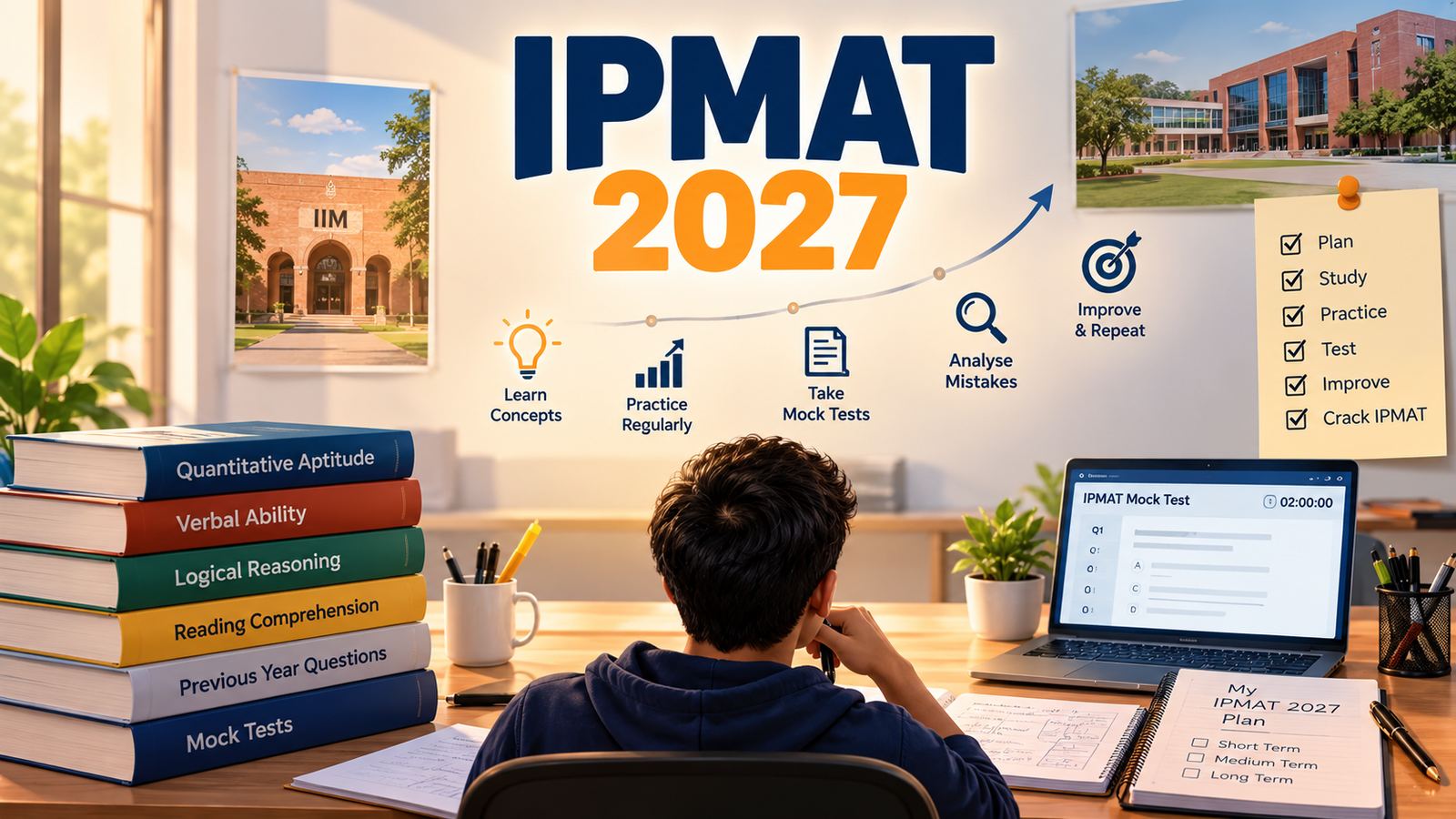
Preparing for IPMAT 2027 requires a combination of strong fundamentals, regular practice, speed, accuracy and mock-test analysis. Whether you are in Class 11, Class 12 or preparing after Class 12, a structured plan can make your preparation much more effective.
The ideal preparation cycle is:
Learn → Practise → Test → Analyse → Revise → Repeat
What Is IPMAT?
IPMAT, or Integrated Programme in Management Aptitude Test, is an entrance examination used for admission to five-year Integrated Programme in Management programmes offered by participating institutes.
The eligibility criteria, exam pattern and selection process can vary between institutes. Therefore, students preparing for IPMAT 2027 should always check the latest official notification of their target institute.
You can start by understanding the IPMAT Syllabus & Exam Pattern.
How to Start IPMAT Preparation
1. Understand the Exam
Before beginning preparation, identify:
-
Sections and topics
-
Exam duration
-
Question types
-
Marking scheme
-
Eligibility criteria
-
Selection process
This will help you create a preparation plan based on your target examination.
2. Build Your Fundamentals
Start with the basic concepts of Quantitative Aptitude and Verbal Ability.
Quantitative Aptitude:
-
Percentages
-
Ratio and Proportion
-
Averages
-
Profit and Loss
-
Time and Work
-
Time, Speed and Distance
-
Number System
-
Algebra
-
Geometry
-
Data Interpretation
Verbal Ability:
-
Vocabulary
-
Grammar
-
Sentence Correction
-
Para Jumbles
-
Reading Comprehension
-
Verbal Reasoning
Don't begin with difficult questions immediately. First make sure your concepts are clear.
3. Practise Regularly
Follow this progression:
Concept → Basic Questions → Advanced Questions → Timed Practice → PYQs → Sectional Tests
Initially, focus on accuracy. Once your accuracy improves, work on increasing your speed.
Keep an error notebook and record mistakes related to:
-
Concepts
-
Calculations
-
Time management
-
Careless errors
Regular revision of these mistakes can significantly improve your preparation.
4. Develop a Reading Habit
Reading is an important part of verbal preparation.
Spend around 20–30 minutes every day reading newspapers, editorials, essays, business articles or other quality content.
While reading, try to identify:
-
Main idea
-
Author's viewpoint
-
Tone
-
Supporting arguments
-
Inferences
This can help improve both reading comprehension and vocabulary.
5. Start Taking Mock Tests
Don't wait until the final weeks to start testing yourself.
Move gradually from:
Topic Tests → Sectional Tests → Full-Length Mocks
After every mock, analyse:
-
Incorrect answers
-
Questions that took too long
-
Questions you guessed
-
Questions you could have solved but left
-
Topics where accuracy is low
Simply taking a mock is not enough. Mock analysis is where much of the improvement happens.
You can explore the IPMAT Mock Test resources for structured practice.
IPMAT Preparation From Class 11
If you are starting in Class 11, focus on building strong fundamentals rather than taking a large number of mocks.
Your priorities should be:
-
Basic Quant concepts
-
Grammar
-
Vocabulary
-
Reading habit
-
Calculation speed
-
Consistent practice
By the end of Class 11, aim to have a strong foundation so that Class 12 can focus more on advanced practice, PYQs and mock tests.
IPMAT Preparation After Class 12
Students preparing after Class 12 can devote more time to focused preparation.
Start with a diagnostic test to identify your strengths and weaknesses. Then divide your preparation into:
Concept Building → Intensive Practice → PYQs → Sectional Tests → Mocks
Your preparation should become increasingly test-oriented as the examination approaches.
How Many Hours Should You Study for IPMAT?
There is no fixed number of hours that every student needs.
Your study time depends on:
-
Current preparation level
-
Time available
-
School or college workload
-
Preparation timeline
-
Strengths and weaknesses
Instead of focusing only on study hours, track your accuracy, questions solved, topics completed and mock performance.
For a detailed preparation framework, refer to the IPMAT Preparation Guide.
Common IPMAT Preparation Mistakes
Avoid these common mistakes:
-
Starting without understanding the exam
-
Ignoring basic concepts
-
Focusing only on Quant
-
Ignoring reading
-
Using too many books
-
Avoiding timed practice
-
Taking mocks without analysing them
-
Ignoring PYQs
-
Repeating the same mistakes
-
Focusing only on study hours instead of improvement
Final IPMAT 2027 Preparation Strategy
A simple strategy to remember is:
BUILD → PRACTISE → TEST → ANALYSE → IMPROVE
Build your concepts, practise consistently, test yourself, analyse your mistakes and keep improving.
IPMAT preparation is not about studying for the maximum number of hours. It is about using your preparation time effectively and improving consistently.
For a structured study plan, explore the IPMAT Strategy page.